
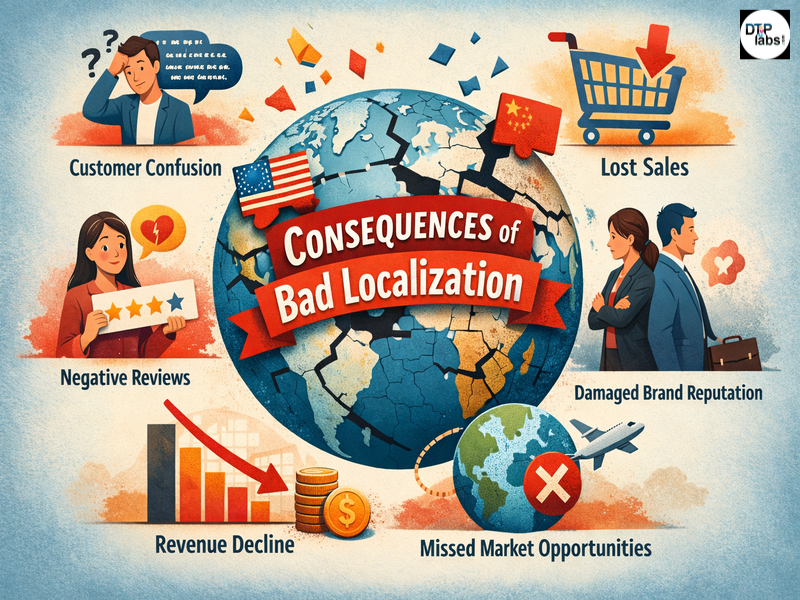
Common Localization Mistakes
Because localisation is far more complicated than simple restatement, errors are more likely to occur. Additionally, as localisation is essential to the success of e-commerce, minor offences can have a detrimental impact on your service quality, brand identity, and ambitions for international expansion. Which localisation hazards are most prevalent, then? We’ve collected them for you.
Disproportional Texts
Since a restated textbook rarely takes up the same amount of space as the source language, language and Localization should be taken into consideration from the very beginning of an e-commerce website’s design. For example, consider the typical call-to-action “Buy Now.” It is more than twice as long when translated into French as “Acheter maintenant.” A localisation specialist must come up with a unique expression that preserves the intended communication while fitting the limited area to prevent l.
Odd Idioms
Rephrasing idioms and conceits word for word, especially when relying just on repetition memory, can produce embarrassing or misleading outcomes when a product or brand uses informal language to convey a warm or authentic tone.”Finger-Lickin’ Good!” is a well-known example of a catchphrase from KFC. which, when translated literally into Chinese, sounded like “Eat your fritters offInstead of following the precise language, transcreation is required to recreate the original tone, emotion, and impact of the communication.
Missing Characters
Numerous character and letter encodings must be supported by computers, however, transferring data between different encodings or systems might cause corruption. No matter the platform, device, operation, or language, Unicode gives each character a distinct code. However, if your e-commerce website isn’t properly set up to accommodate similar standards, characters from non-ASCII rudiments like Japanese might not appear appropriately. Modernising your software and website with the assistance of experts who adhere to localisation style guidelines is crucial to avoiding these problems.
Being Unaware of Dialects
For example, the Spanish spoken in Argentina or Mexico is very different from the Spanish spoken in Europe. Artistic distinctions between areas that speak the same language can often be just as striking as those between nations that speak completely different languages. Effective localisation should therefore focus on the particular geographic area in addition to the language itself.
Ignoring Place Names
While “England” is spelled the same way in Danish, it becomes “İngiltere” in Turkish and has various translations in many other languages. Despite this, country names—which are just as significant as specific names—are often left untranslated. In addition to being a grammatical error, the original cult may interpret this as being sleeping, which would be detrimental to their opinion of the brand.
Skewed Texts
Reading direction isn’t universal across languages. Hebrew and Arabic are among the many languages that are read from right to left, whereas many others are read from left to right. Additionally, perpendicular jotting is a tradition in several East Asian languages, and it is still widely used in Japanese. Your e-commerce platform ought to be able to handle these various textbook exposures in order to guarantee a seamless stoner experience.
Confusing Units

The option to browse pricing in their native currency is an initial expectation for the majority of online customers; at the very least, explicit conversion rates must to be offered. In order to accommodate visitors’ habits and preferences, measurements, dates, and other formats should also adhere to the original traditions.
Incorrect Visuals
On an e-commerce site, employing visuals instead of a textbook might sometimes make content easier for multinational cults to understand, but this strategy isn’t always successful. Similar to food markers, books, or periodicals, images containing bedded textbooks should be replicated using a localised textbook. Similarly, depictions that are culturally offensive, like buses travelling on the “wrong” side of the road, ought to be modified to align with initial expectations.
Lost Keywords
Rephrasing keywords word-for-word overlooks the reality that hunt geste varies across countries. Relating SEO keywords that are tailored to each request and based on initial search behaviours is the first step in effective localisation. This procedure necessitates an understanding of how visitors in that area really do online searches.
Irrelevant Content
Every company’s internet presence must include additional material, such as blogs and news articles. Unfortunately, this type of content is frequently released in the corporate language of the company or simply in English, making it irrelevant to consumers in other areas where people speak different languages. A company should produce pertinent, localised content in collaboration with regional bloggers and influencers or hire qualified language services with native translators to increase brand awareness and consumer momentum in each area.
Negligent Acts
Commerce brands must exercise caution to avoid inadvertently offending people in various cultures and geographical areas. For example, it’s crucial to remember that imagery and symbols might have different cross-cultural meanings. When Fiat sent thousands of “love letters” to young ladies in Spain asking them to “get together with their new Fiat 500 car,” it was an example of how misguided marketing strategies can cause global crises. Many ladies were terrified, thinking they were being harassed by a stranger.
Disregarding Local Regulations
Regional differences exist in legal requirements and e-commerce activities. Complying with regional regulations requires in-depth legal research and expertise. A translator/localization specialist or a professional language service with knowledge of the language, the legislation, and the region should manage legal translation issues.
Missed Sales Opportunities
Legal regulations and e-commerce activity vary by region. It takes extensive legal research and knowledge to comply with local legislation. Legal translation concerns should be handled by a translator/localization specialist or a professional language agency with expertise in the language, the law, and the area.
Inadequate Localization Testing
Frequent localisation testing can provide your brand with enormous international prospects. The only way to ensure that every aspect is meticulously examined is by an outside team of testers who are knowledgeable about the language, customs, and specifications of each local market. neglected, and that the website is user-friendly for search engines and customers in all languages. 
Stale Content
Translations on an e-commerce website should be updated on a regular basis to guarantee that the content is current. has an exciting context, and is relevant to the target region and its language. Refreshing your content also boosts your website’s search engine rankings and provides an opportunity to introduce new product features and pricing changes.
Conclusion
Effective localization goes beyond translation—it ensures your content is culturally relevant, technically accurate, and market-ready. Avoiding common localization mistakes helps protect brand reputation, improve user experience, and unlock global growth opportunities.