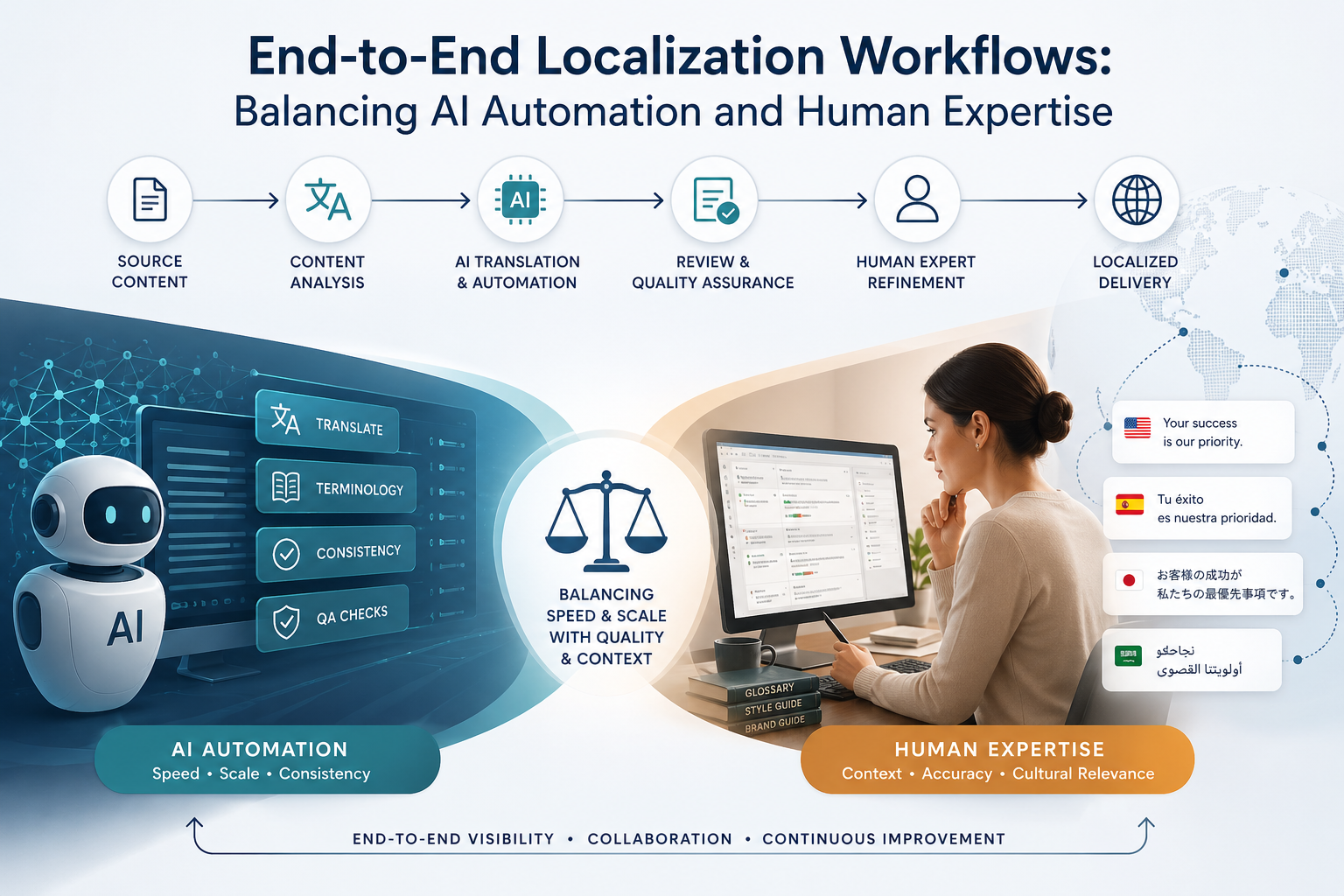
End-to-End Localization Workflows: Balancing AI Automation and Human Expertise
End-to-end localization workflows now span six interconnected stages — from source content intake through machine translation, linguistic QA, engineering, desktop publishing, and final delivery — with AI automation increasingly embedded at every step. Modern systems can pre-translate thousands of words in seconds, enforce terminology automatically across 80+ file formats, and even auto-adjust layouts when text expands. But human experts remain essential for cultural nuance, creative copy, complex bidirectional layouts (Arabic, Hebrew, CJK), legal and medical accuracy, and accessibility compliance. This guide examines the complete localization pipeline in the AI era — defining each stage, identifying where AI excels (mass throughput, automated QA, terminology), where it falls short (creative tone, complex layouts, compliance), and the best practices that combine machine speed with human judgment.